

In this article we break down what anxiety is, why some people are more likely to have difficulties with anxiety than others and what to look out for if you think your anxiety might be a problem. At the end we talk about how health professionals like psychiatrists can help you if you are struggling and describe some simple breathing techniques you can try.
What is Anxiety?
Anxiety is a normal, evolutionary mechanism that developed to keep us safe. When you are feeling anxious, your body is on high alert. Your amygdala in your brain senses danger and your brain activates your sympathetic nervous system, releasing hormones – adrenaline and cortisol – which surge round your body. Your heart starts racing, pumping blood to your muscles, which tense, ready to run away from the situation. You start breathing faster, and become hyperaware of what is around you. Sometimes you may feel sick or have butterflies in your stomach. This is great – if you are about to be hit by a car and need to run – but not so great if you are stuck in a meeting and have just been asked a difficult question.
Who experiences Anxiety?
Everyone. You cannot be a human and have not felt anxiety at some point of your life. Anxiety prepares us for challenges and kept us alert to threats. Mild anxiety can be useful, for example to improve focus when you are public speaking, to motivate you to study, to prepare you for a job interview or to enable you to perform at your best at a sporting event. However, problems can arise when your anxiety is triggered too often or occurs in areas of your life that should not trigger anxiety. This can impair your ability to function rather than protecting you. If these situations sound familiar then you may have a problem with anxiety, also called an ‘anxiety disorder’.
Anxiety Symptoms
Anxiety can affect the way you think and also cause unpleasant physical sensations in your body. Your brain might repeatedly worry about the same thing over and over. You might always jump to the worst possible outcome or find it hard to switch your brain off. This can make it difficult to concentrate or fall asleep. You also might feel paralysed when asked to make a decision because you are worried about the outcome.
Physical symptoms of anxiety
It is common to experience physical symptoms of anxiety. These can also make you feel more anxious because your brain thinks that something might be wrong. This can create a vicious cycle. For example you might feel a tightness in your chest or your heart beating fast (palpitations), and think there is something wrong with your heart. You also might feel sick, experience increased sweating or tension headaches. You may experience panic attacks where you have pain in your chest, feel dizzy and short of breath. These can be scary and come out of the blue.
Anxiety Test
If you think you might be experiencing anxiety symptoms, why not take a quick test to see if you have a problem with anxiety? This test is adapted from the GAD-7, a validated screening questionnaire for generalised anxiety disorder. This test cannot diagnose anxiety disorders on its own but it is a helpful tool to use to decide if you need to see a professional for help.
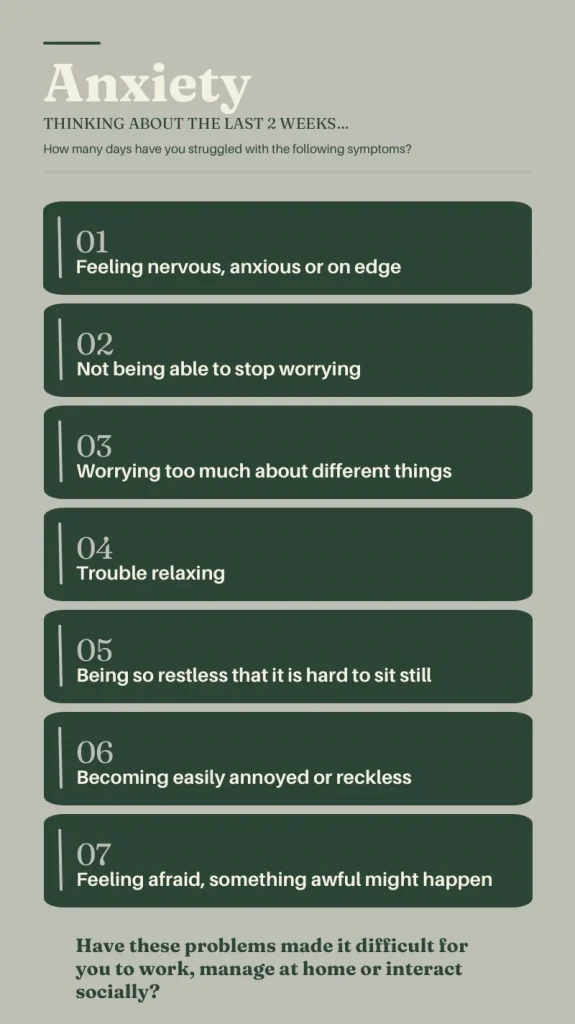
Okay, think about the last 2 weeks.
Did you struggle with any of these issues on a daily basis?
Did they stop or make it hard for you to do what you wanted or needed to do?
Try to work out if you found them hard several days, more than half the days or every day.
If you have been bothered by most of these symptoms for at least half of the days then this is a sign you may have a problem with anxiety.
Anxiety Disorders
If you have a problem with anxiety that stops you from functioning, we call it an anxiety disorder. Anxiety disorders are the most common type of mental health problem worldwide, affecting almost 360 million people at any time.
Anxiety disorders can affect anyone but more women experience high levels of anxiety symptoms, compared to men. In Scotland around 16% of adults regularly experience two or more symptoms of anxiety. Please don’t feel ashamed or embarrassed for struggling with anxiety. It is important to speak to others about how you are feeling and you may find they have had similar experiences.
There are many different types of anxiety disorder. The most common type of anxiety problem is Generalised Anxiety Disorder (GAD). It currently affects 8% of adults in the UK. We describe how it and other anxiety problems might affect you below:
Generalised Anxiety Disorder (GAD)
You feel worried most of the time, about many different things, and you are not sure why. You feel restless, on edge and might be irritable with other people. It makes it hard to do things day to day and might affect your sleep.
Social Anxiety Disorder
You find it difficult being out in public or in social situations because you are anxious people may be looking at you or judging you. This can make it tempting to avoid going out which usually leads to increased fear about socialising over time.
Panic Attacks or Panic Disorder
You experience intense anxiety attacks or panic attacks, where you feel overwhelmed and have a sense that something awful could happen. These happen out of the blue and you might feel nauseated or short of breath. You may also get tightness in your chest or heart palpitations.
Phobia
You have an intense fear of a specific thing or situation, e.g. flying or bees. You avoid these or feel very anxious if you encounter the thing, like a bee in the garden, or make yourself face the situation e.g. taking a flight to see a relative.
Obsessive Compulsive Disorder (OCD)
You have intrusive thoughts that are horrifying to you – awful things happening to family or friends, vivid pictures of disasters – and feel compelled to behave in certain ways e.g. counting, washing your hands five times, to prevent these from happening. You might know logically that your actions do not have that power but you cannot stop yourself from performing these rituals or routines.
Post-Traumatic Stress Disorder (PTSD)
You have experienced something awful and traumatic. After this event happens (or events) you begin to have nightmares of the event, have sudden visual memories of what happened and feel on high alert. You tend to avoid things that might remind you of the event too.
You can also have more than one or you might experience different anxiety problems throughout your life. When you see a psychiatrist you will be asked about your symptoms, when they occur and how they impact your life. This allows us to establish what type of anxiety condition you are experiencing and to tailor your treatment plan accordingly. You may have problems with other areas too, such as: health anxiety, body dysmorphic disorder or agoraphobia.
What causes Anxiety?
There are many reasons why you might develop a problem with anxiety. Anxiety issues often start earlier in life but can occur at any age.
- Genetics
Like many mental health disorders if you have close family members (first degree relatives) who experience anxiety then you are more likely to experience anxiety too.
- Brain Development
Chemicals in the brain, especially neurotransmitters (serotonin and gamma-aminobutyric acid) and cortisol are involved in causing symptoms of anxiety and panic. It is also thought that dysfunction in the amygdala, the area of your brain that processes fear, also contributes to you developing anxiety. You may have noticed that even from a young age some children appear more anxious than others.
- Environment Factors
Certain medication or stimulants such as caffeine can cause symptoms of anxiety. For example, caffeine can cause palpitations. If you are having to manage stressful life events such as health concerns, the breakdown of a relationship or financial pressures these can cause anxiety and episodes of panic.
- Adverse Childhood Experiences (ACEs)
Your childhood experiences influence how we manage stress and anxiety as an adult. It is understood that if you are exposed to adverse childhood experiences such as emotional, physical or sexual abuse then you have an increased likelihood of developing an anxiety or panic disorder as an adult.
- The Situation
Episodes of panic can occur in response to a situation for example public speaking or feeling trapped. If you experience an episode of panic, it can lead to avoidance of the situation that caused it and change your behaviour moving forward. Your brain can start to believe that certain situations are unsafe leading to further avoidance.
How to Deal with Anxiety?
If your anxiety is impacting your life, affecting your work, relationships or sleep you might benefit from seeing a psychiatrist. If you experience anxious thoughts about small things, if your anxiety feels more difficult to manage or is impacting you on a daily basis, then it is time to reach out for professional help. We understand that seeking help can itself be anxiety provoking. However, it is the first step to start to take control and improve your anxiety.
How to reduce anxiety immediately
In the moment there are a few things you can try to help quieten down your anxiety and help you feel more in control.
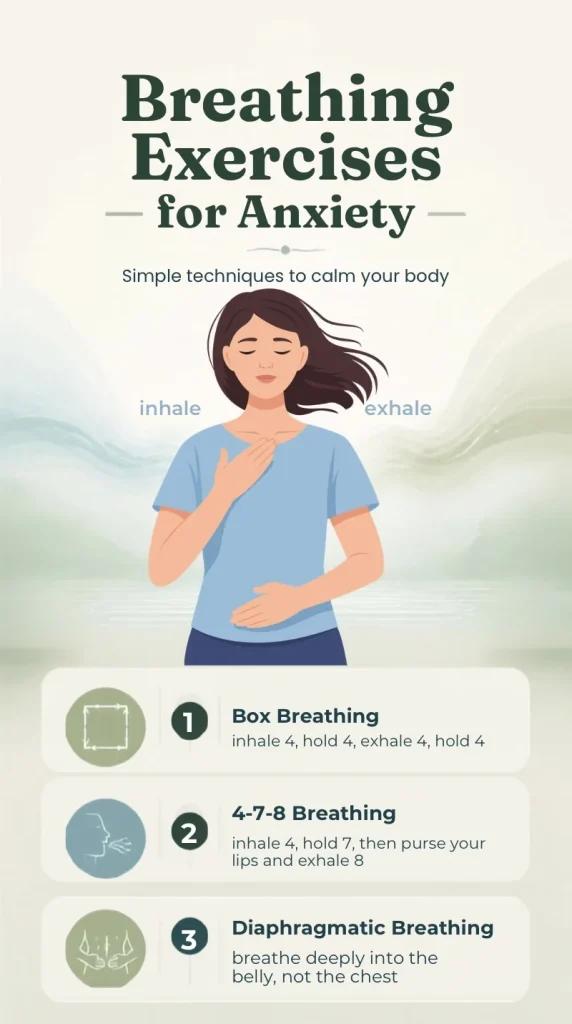
- Ground yourself – look at what is around you. Name 5 things you can see, 4 things you can touch and 3 things you can hear.
- Name the anxiety – say “I am feeling anxious” out loud. The anxiety is a feeling. It is okay to have feelings but they do not have to control you. Tell yourself you are safe.
- Relax your muscles – squeeze your hands into fists, curl your toes tight… and then unclench them.
- Try some breathing exercises – we have put some examples on the left.
Medication for anxiety
There are a number of medicines you can be prescribed for anxiety disorders. These include medications such as Selective Serotonin Re-uptake Inhibitors (SSRIs) or Selective Noradrenaline Reuptake Inhibitors (SNRIs). When you see a psychiatrist they can talk through what might be helpful for you. They also are experienced at managing complex cases, where a combination of medications might be best to manage your symptoms. You will always have a discussion about potential benefits and side effects before you start medication. The aim is to improve your anxiety symptoms, and all treatment planning will be done in collaboration with you.
Therapy for anxiety
Psychological therapies such as cognitive behavioural therapy or exposure response prevention are also an evidence-based treatment for anxiety. Psychological therapy can be a treatment option with or without medication. Many people find a combination of both to be the most helpful treatment and we can refer you to excellent professionals to help you.
Final Thoughts…
Anxiety helps you avoid danger and allow you to perform at your best under pressure. It is a normal part of life but some of us are more prone to it than others. If you feel overwhelmed by your anxiety or it is impacting your quality of life then it is time to see a psychiatrist. Please do not worry about reaching out – it is a safe space to discuss your concerns and psychiatrists have years of experience hearing all the wild things that our brains can conjure up.
Anxiety problems are common but also treatable. You do not need to manage anxiety alone.
Sources
Alonso J, Liu Z, Evans-Lacko S, et al. Treatment gap for anxiety disorders is global: results of the World Mental Health Surveys in 21 countries. Depress Anxiety. 2018;35(3): 195-208.
ONS. (2023) Public opinions and social trends, Great Britain: personal well-being and loneliness.
Population Health Directorate. (2022) The Scottish Health Survey, volume 1: main report.
Dr Amy Martin is a consultant psychiatrist, and co-founder of The Mind & Psychiatry Clinic. She provides private psychiatric services in Edinburgh and via secure video consultation across the UK.